 How-to
How to Research Ethical Beauty Supply Chains
Last Updated: November 4, 2026
Quick Summary
Research ethical beauty supply chains by tracing each ingredient on the INCI list back to its origin, then verifying every certification with its issuing body. Marketing claims describe intent, while supply chain records show what actually happened. Only verifiable records can back up an ethical claim.
- Write down each ingredient from the INCI list and note its origin country.
- Check each certification in the issuing body's public directory to confirm it is current.
- Mica, palm-derived ingredients and botanicals deserve extra attention in sourcing checks.
- Vague terms like clean or eco-friendly rarely come with a definition, so ask the brand.
- Score each claim as Verified, Unverified or Missing, and set your tolerance before buying.
Table of Contents
- Why Supply Chain Research Matters More Than Marketing Claims
- Understanding Supply Chain Transparency and Traceability
- Mapping a Product's Supply Chain to the Source
- Sourcing Raw Materials: Mica, Palm Oil and Botanicals
- Ethical Beauty Certifications: What Each Label Actually Verifies
- How to Spot Greenwashing in Skincare Before You Buy
- Ethical Consumerism Tools and a DIY Audit You Can Run This Week
- Putting Your Research to Work on Your Next Skincare Purchase
- Frequently Asked Questions
Ethical beauty supply chains are harder to verify than most skincare labels suggest. The global sustainable beauty and skincare market was valued at USD 224.3 billion in 2026 (Future Data Stats market valuation), and 64% of global beauty consumers say a brand's ethical commitments shape what they buy (Market.us skincare statistics). This guide shows you how to research ethical beauty supply chains yourself, step by step, so you can tell real sourcing from clever marketing.
Why Supply Chain Research Matters More Than Marketing Claims
Most ethical claims are easy to write and hard to check. A label that says "clean" or "natural" tells you what the marketer wants you to believe, not where the ingredients came from.
Research on sustainability in cosmetics points the same way. Pressure around ethical sourcing has grown across global supply chains, and brands are being pushed to prove their claims (ScienceDirect study on sustainability-oriented innovation in cosmetics).
- Marketing claims describe intent
- Supply chain records describe what actually happened
- Only the records can back up the claim
Understanding Supply Chain Transparency and Traceability
Traceability means you can follow an ingredient from the finished bottle back to the farm, mine or lab where it started. Transparency means the brand is willing to show that path to you.
Brands are moving away from simple claims toward traceable, biotech-based sourcing (Personal Care Insights on traceability trends). That shift helps shoppers, because verifiable records are easier to check than slogans.
Mapping a Product's Supply Chain to the Source
Start with the product in front of you. Pull up the full ingredient list, often called the INCI list, and note every botanical, mineral and oil.
Then trace each one back. Ask where the raw material is grown or mined, who processes it and who sells it to the brand.
- Write down each ingredient from the INCI list
- Note the origin country for each botanical
- Find the first supplier the brand names, if any
- Flag any ingredient with no stated origin
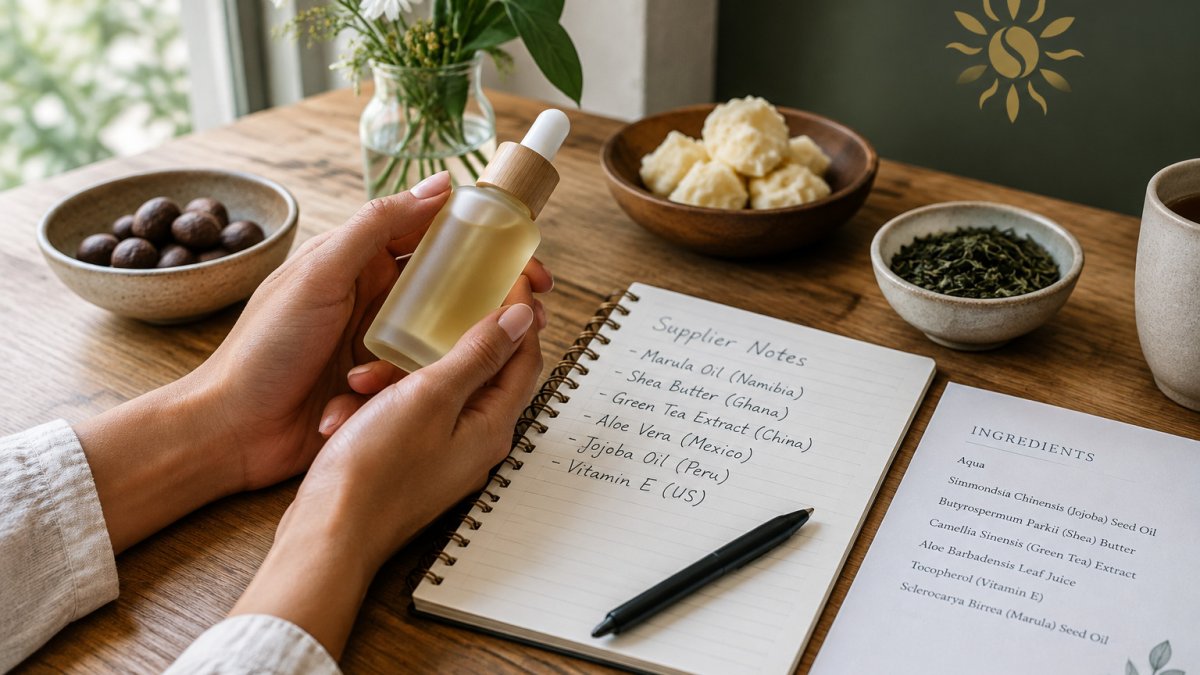
A pair of hands with a skincare bottle and handwritten notes makes this process concrete. Keep your notes in one place so you can compare brands later.
Sourcing Raw Materials: Mica, Palm Oil and Botanicals
Three raw materials deserve extra attention. Mica, used for shimmer, has a history tied to labor concerns in mining. Palm-derived ingredients raise questions about deforestation. Botanicals raise questions about fair pay and growing conditions.
Look for the origin and any certification each one carries. A USDA-certified organic jojoba oil, for example, gives you a checkable signal rather than a vague promise (USDA National Organic Program).
Our own botanicals are listed with their sourcing details, and you can see how we approach them on our shop our botanical clean skincare range.
Ethical Beauty Certifications: What Each Label Actually Verifies
Certifications are useful, but each one checks something different. A label may cover organic farming, animal testing, fair trade or carbon reporting, and none of these guarantees the whole supply chain is clean. The fastest way to research a seal is to know which body issues it, what standard it audits against, and whether the audit reaches suppliers or stops at the final factory.
Here is what the most common beauty certifications actually verify:
- COSMOS Organic (COSMOS-standard.org), issued by an international non-profit standard. It certifies organic content and processing for cosmetics, and requires a minimum share of organic ingredients plus restrictions on petrochemical inputs. It does not certify labor conditions at the farm.
- USDA National Organic Program (USDA.gov), a government standard for agricultural ingredients. A product can carry the USDA seal only if at least 95% of its ingredients (by weight, excluding water and salt) are certified organic. It covers growing and handling, not mining or fair pay.
- Fairtrade International (Fairtrade.net), audits pay, working conditions and a minimum price for smallholder farmers and workers. It applies to specific commodities such as cocoa, shea and some oils, so a Fairtrade mark on one ingredient says nothing about the rest of the formula.
- Leaping Bunny (LeapingBunny.org), a cruelty-free program run by the Coalition for Consumer Information on Cosmetics. It requires a supplier monitoring system and independent audits, but it does not address environmental or labor sourcing.
- B Corp Certification (Bcorporation.net), a whole-company assessment covering governance, workers, community, environment and customers. It is not ingredient-specific, so a B Corp score reflects overall operations rather than a single product's supply chain.
- ECOCERT (Ecocert.com), a certification body that issues organic and natural cosmetic standards. Its scope depends on the specific standard applied, so read which ECOCERT standard the product claims.
A common pattern is that a brand displays one seal and lets shoppers assume it covers everything.
Watch out: A certification can be expired, superseded, or issued for a different product line than the one you are holding. Check the certifying body's public directory for the brand's current status before you trust the seal.
Some brands also publish third-party eco-certifications and carbon data as standard practice (XJ Beauty on supply chain resilience). Treat that as a starting point, then check the scope yourself. The certifying body's own standard document is the only reliable source for what a seal verifies.
Each certification checks something different, so here is what the most common labels actually cover.
| Certification | What it verifies | What it does not cover |
|---|---|---|
| COSMOS Organic | Organic content and processing for cosmetics | Labor conditions at the farm |
| USDA National Organic Program | At least 95% certified organic ingredients (by weight, excluding water and salt) | Mining or fair pay |
| Fairtrade International | Pay, working conditions and minimum price for smallholders | Ingredients outside the certified commodity |
| Leaping Bunny | Supplier monitoring system and independent audits for cruelty-free status | Environmental or labor sourcing |
| B Corp Certification | Governance, workers, community, environment and customers at company level | Single-product supply chain |
| ECOCERT | Organic and natural cosmetic standards | Depends on the specific standard applied |
How to Spot Greenwashing in Skincare Before You Buy
Greenwashing usually hides in vague words. Terms like "clean," "eco-friendly" and "ethically sourced" sound specific but rarely come with a definition.
The "clean beauty" label is especially hard to verify, because complex global supply chains make a fully clean chain close to impossible for many brands (Associated Press reporting on clean beauty claims). Ask the brand to define the term.
Watch for these red flags:
- Claims with no named standard or certifying body
- Photos of nature that do not match where ingredients come from
- Sustainability badges the brand created itself
- No supplier information when you ask for it
Watch out: A brand can be honest about one ingredient and silent about the rest. Check every ingredient that matters to you, not just the hero botanical on the front label.
Ethical Consumerism Tools and a DIY Audit You Can Run This Week
Most guides tell you to "do your research" and stop there. This section gives you a repeatable five-step audit and the specific public tools to run it, so you can finish a product check in one afternoon without special software.
Step 1: Collect the paper trail. Save the full INCI list, every certification name and logo, and any supplier statements from the brand's website or product page. Screenshot the sourcing page, because brands update these quietly.
Step 2: Verify each certification against its issuing body. Do not trust the logo on the box.
Step 3: Trace the hero ingredients. For each botanical, mineral or oil, check whether the brand states an origin country and a first supplier.
Step 4: Score each claim. Use a simple three-column table: Verified, Unverified, Missing. A claim is Verified only when a named third party confirms it. Unverified means the brand asserts it but no independent record exists.
Step 5: Set your acceptance threshold and log the result. Decide in advance how many Unverified claims you will tolerate, then record the brand, product, date and score in a spreadsheet.
Digital tools worth bookmarking:
- USDA Organic Integrity Database, confirms whether a supplier is certified organic.
- Fairtrade International producer directory, confirms certified cooperatives by country and commodity.
- COSMOS and ECOCERT public registers, confirm organic and natural cosmetic certification status.
- Open Supply Hub (opensupplyhub.org), a free, open database of facility-level supply chain data that some beauty and personal care brands publish to.
- CDP disclosure portal, shows which companies report climate and water data, useful for checking carbon claims.
- Good On You and the Ethical Consumer brand ratings, independent ratings you can use as a cross-check, not a substitute for primary documents.
Watch out: A brand's own "sustainability report" is marketing until a third party verifies it. Use it to find supplier names, then confirm those names in the public databases above rather than accepting the report's conclusions.
Keep a short list of brands that pass your threshold so you can reuse it. The goal is not a perfect score, it is a documented, repeatable check you can defend.
Putting Your Research to Work on Your Next Skincare Purchase
Use your audit before each purchase, not just once. Ingredients change, suppliers change and certifications expire, so a result from last year may not hold today.
When a brand passes your checks, buy with confidence. When it fails, you have a clear reason to walk away.
If you want to start with products that are easy to trace, browse our aura cacia organic jojoba oil and jasmine absolute in jojoba oil listings to see how a single-ingredient label reads.
Frequently Asked Questions
What is an ethical supply chain in the beauty industry?
An ethical supply chain is one where every stage, from raw material extraction through manufacturing and distribution, can be traced and shown to meet standards on labor rights, environmental impact and fair trade. In beauty, this matters most for ingredients such as mica, palm-derived oils and botanical extracts, where sourcing can involve child labor, deforestation or unfair payment to farmers. Research 2026 indicates that 64% of global beauty consumers weigh a brand's ethical and sustainable commitments when buying, so brands are under growing pressure to show verifiable documentation rather than general claims.
How can consumers identify greenwashing in beauty supply chains?
Start by checking whether a brand names its suppliers, discloses where raw materials originate and backs claims with third-party verification. Vague terms such as 'natural', 'clean' or 'eco-friendly' without definitions are a common warning sign. Industry analysis from 2026 notes that credible brands increasingly provide carbon reporting and eco-certifications, so the absence of any documented proof is a reason to look more closely. Treat any claim you cannot trace back to a verifiable source as unproven until shown otherwise.
Which third-party certifications verify ethical beauty supply chains?
Certifications differ in scope, so check what each one actually covers. Organic certification addresses how ingredients are grown, while fair trade and labor-focused schemes address working conditions. Look for certifications that are independently audited and that list the specific standard they meet, not just a logo. Because the credibility of sustainability schemes depends on transparency across agricultural and artisanal supply chains, a certificate is strongest when the brand also publishes its supplier information.
What is the difference between 'clean' beauty and 'ethical' beauty?
'Clean' beauty usually refers to what is excluded from a formula, such as certain synthetic ingredients, while 'ethical' beauty refers to how ingredients are sourced and how workers and the environment are treated. A product can be clean in its formula and still come from a supply chain with labor or environmental problems. Associated Press reporting has also noted that the 'clean' label is difficult to verify given complex global supply chains, so it is worth researching sourcing separately from formulation.
Ready to shop with clearer answers? Explore the full Soulari Naturals collection, check the INCI lists yourself, and see the sourcing details for each formula before you choose.