 how-to
How to Identify Greenwashing in Beauty Products
Table of Contents
- What Greenwashing in Beauty Looks Like Today
- Greenwashing Buzzwords in Skincare to Treat as Red Flags
- How to Read Skincare Ingredient Labels Without Getting Fooled
- Clean Beauty Certifications to Look For (and What They Actually Verify)
- Transparency in Beauty Labeling: What Real Disclosure Requires
- Beyond the Label: Digital Footprint and DIY Verification Tools
- Conclusion
- Frequently Asked Questions
Last Updated: October 2, 2026
What Greenwashing in Beauty Looks Like Today
Greenwashing in beauty is when a brand makes a product seem more natural, safe, or eco-friendly than it really is. The claim sounds green. The formula often is not. This guide shows you how to spot the difference in seconds.
The playbook is simple, and it is everywhere:
- A leaf icon on a bottle of synthetic fragrance
- "Chemical-free" on a product made entirely of chemicals (water is a chemical)
- "Eco-friendly" packaging that cannot be recycled anywhere
The 7 Sins of Greenwashing, Explained
TerraChoice researchers first named the "seven sins of greenwashing," and the list still holds up. The most common in beauty:
- Hidden trade-off - one green claim hides a bigger problem
- No proof - a claim with no evidence behind it
- Vagueness - "all natural" means nothing specific
- False labels - fake certification seals
- Lesser of two evils - "organic" cigarettes logic
- Fibbing - outright false claims
- Worshipping false labels - implying a certification that does not exist
TerraChoice's Seven Sins of Greenwashing report
Why 'Natural' Is Not a Regulated Term
Here is the fact that changes how you shop: in most markets, "natural" and "clean" have no legal definition for cosmetics. A brand can put either word on any bottle.
Greenwashing Buzzwords in Skincare to Treat as Red Flags
Certain greenwashing buzzwords in skincare show up again and again because they work. They sound scientific and safe at the same time. Most are neither.
Watch for these:
- Chemical-free - impossible; everything is a chemical
- Non-toxic - undefined and unenforceable
- Clean - no legal meaning in cosmetics
- Detoxifying - your skin does not detox; your liver does
- Botanical - poison ivy is botanical
- Dermatologist-tested - vague; tested how, by whom?
How to Read Skincare Ingredient Labels Without Getting Fooled
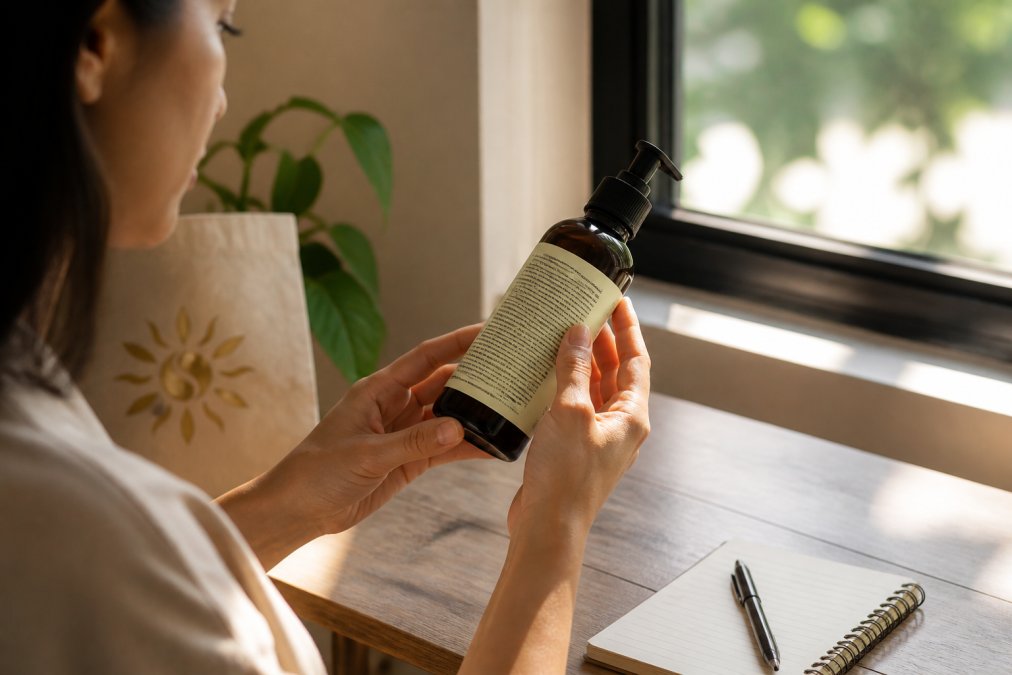
Learning how to read skincare ingredient labels is the fastest way to cut through greenwashing. The back of the bottle is where the truth lives, because ingredient lists follow real rules.
A 5-Step INCI List Reading Method
The INCI list is the standardized ingredient name system used worldwide. Here is how to read it:
- Find the first five ingredients - these make up most of the formula
- Check where the "star" ingredient sits - if it is after the preservative, it is likely trace
- Learn your red-flag names - "fragrance" and "parfum" hide dozens of compounds
- Note the preservatives - phenoxyethanol and sodium benzoate are common and well-studied
- Scan for claims that contradict the list - "fragrance-free" with parfum listed is a lie
Clean Beauty Certifications to Look For (and What They Actually Verify)
Real clean beauty certifications to look for verify something specific. A logo with no backing verifies nothing. The problem is that seals operate at different scopes, some certify a single ingredient, some certify a whole formula, and some certify the entire company. A brand can hold a company-level seal while selling a formula that would fail an ingredient-level standard. Knowing which scope a seal covers is the difference between a real signal and a decorative sticker.
| Certification | Scope | What It Actually Verifies | What It Does NOT Verify |
|---|---|---|---|
| COSMOS ORGANIC / COSMOS NATURAL | Formula | Organic and natural sourcing standards, restricted ingredient list, some packaging rules | Social or labor practices; carbon footprint |
| USDA Organic | Formula | Organic agricultural content (95%+ for "Organic," 70%+ for "Made with Organic") | Non-agricultural ingredients; sustainability of the supply chain |
| Leaping Bunny | Company | No animal testing at any stage, including suppliers | Ingredient safety, environmental impact, or sourcing ethics |
| B Corp | Company | Company-wide social and environmental performance, verified by B Lab | Any individual product's formula or ingredient sourcing |
| EWG Verified | Formula | Ingredient safety screening against EWG's own hazard database | Environmental impact; EWG is a nonprofit, not a regulator |
| NATRUE | Formula | Natural and organic cosmetic standards across three tiers | Social or labor practices |
How to Actually Verify a Seal
A seal is only as good as the certifying body behind it. Three checks catch most fakes and expired claims:
- Search the certifying body's own database, not the brand's site. COSMOS, USDA Organic, Leaping Bunny, B Corp, and NATRUE all publish searchable lists of certified companies and products. If the product is not listed, the seal is decoration.
- Check the scope against the claim. A B Corp logo on a bottle does not mean the formula is clean, it means the company passed a social and environmental audit. A Leaping Bunny logo does not mean the ingredients are safe. Match the seal to the claim it is being used to support.
- Look for an expiration or certification number. Most programs require annual renewal. A seal with no ID number and no visible date is harder to verify and easier to fake.
The Regulatory Loophole Competitors Skip
Here is the part most guides leave out: in the United States, the FDA does not pre-approve cosmetic claims or certification seals before a product hits shelves. The FDA regulates cosmetics for safety and labeling, but it does not certify "natural," "clean," or "green." That means a brand can print a seal-shaped graphic on a bottle and the only enforcement mechanism is a complaint filed after the fact.
Transparency in Beauty Labeling: What Real Disclosure Requires
Transparency in beauty labeling means the brand shows you the full formula, not just the highlights. Full disclosure is the only claim that cannot be faked, but "full" is doing a lot of work in that sentence, because the standard INCI list has a built-in loophole.
The Fragrance Loophole
Under U.S. and EU labeling rules, a brand can list the single word "fragrance" or "parfum" and legally conceal anywhere from a handful to dozens of individual compounds. Fragrance is treated as a trade secret, so the components do not have to appear on the label. This is the single biggest disclosure gap in cosmetics, and it is why "fragrance-free" and "unscented" are not the same claim:
- Fragrance-free means no fragrance has been added, but masking fragrances can still be present to cover the smell of raw ingredients.
- Unscented means the product has no noticeable scent, which often means a masking fragrance was added.
A Transparency Audit You Can Run in Five Minutes
Real disclosure is testable. Here is how to audit a brand's transparency claim instead of taking it at face value:
- Find the full INCI list on the product page, not just the front-of-bottle highlights. If the brand lists "key ingredients" but not the complete formula, that is a partial disclosure.
- Check whether fragrance components are named. Look for individual allergens like limonene, linalool, citronellol, geraniol, and eugenol. Their presence is not automatically bad, but their absence from a scented product usually means the brand is using the "parfum" loophole.
- Look for ingredient percentages on actives. A brand that says "10% niacinamide" is disclosing. A brand that says "niacinamide" with no number is not.
- Check the sourcing page. Does the brand name the country or region for key ingredients, or does it use phrases like "ethically sourced" with no specifics? "Sourced from a family farm in Provence" is disclosure. "Sustainably sourced" is not.
- Email the brand one specific question. Ask for the full INCI list including fragrance components, or ask for the percentage of the hero active. A transparent brand answers with a document. A greenwashing brand answers with a link to a lifestyle page.
What "Proprietary Blend" Actually Hides
"Proprietary blend" and "botanical complex" are legal ways to avoid disclosing ingredient ratios. The INCI list still has to name the ingredients in descending order of concentration, but a blend lets a brand group several ingredients together and list them as one line, which means a trace amount of a hero botanical can sit next to a much larger amount of a filler without the ratio being obvious.
Beyond the Label: Digital Footprint and DIY Verification Tools
Most guides stop at the label. That is a mistake, because a brand's digital footprint often contradicts its packaging.
Run a quick social media audit:
- Search the brand's name plus "lawsuit" or "recall"
- Check whether sustainability posts include specific data or just stock photos
- Look for ingredient sourcing details on their site, not just lifestyle imagery
Clean Beauty vs. Green: A Distinction That Changes What You Buy
Clean beauty and green beauty are not the same thing, and mixing them up leads to bad buys.
Conclusion
The hardest part of avoiding greenwashing is that the misleading claims look exactly like the honest ones. The fix is a habit: ignore the front of the bottle, read the INCI list, and verify every certification at its source.
Frequently Asked Questions
How can I tell if a beauty brand is greenwashing?
Look for vague claims with no proof, like 'chemical-free' or 'eco-friendly,' and check whether the brand publishes a full INCI list. If a product leans on nature imagery, green leaves, or the word 'natural' without third-party certification or ingredient transparency, treat it as a greenwashing indicator. Real transparency means named ingredients, verifiable certifications, and supply chain accountability you can check yourself.
What are the most common greenwashing buzzwords in skincare?
The biggest offenders are 'natural,' 'clean,' 'non-toxic,' 'chemical-free,' and 'eco-friendly.' None of these are regulated terms, so any brand can print them. 'Biodegradable' and 'cruelty-free' are also frequently used without certification. When you see these words, look for the specific proof behind them: an organic certification, a named third-party audit, or a full ingredient list that supports the claim.
How do I read an INCI list to avoid greenwashing?
Start at the top, where ingredients are listed by concentration. Identify the first five: if water and alcohol lead and the 'botanical actives' sit near the bottom, the plant content is minimal. Look up any unfamiliar names in a cosmetics ingredient database. A brand committed to transparency in beauty labeling will publish the full INCI list with no hidden formulas, so you can verify every claim yourself.
What certifications actually prove a product is clean?
COSMOS Organic, ECOCERT, and NATRUE verify organic content and manufacturing standards. Leaping Bunny and Cruelty Free International confirm cruelty-free claims. USDA Organic and Soil Association certifications cover organic sourcing. Each one audits a specific claim, so match the certification to what the brand is promising. A logo alone is not enough; check the certifying body's public database to confirm the product is listed.