 how-to
Verify Clean Beauty Ingredient Transparency: A Step-by-Step Guide
Table of Contents
- Why Ingredient Transparency Matters in Clean Beauty
- How to Check Skincare Ingredients: Reading Beyond the Label
- Decoding Full INCI Ingredient Lists for Complete Transparency
- Using a Clean Beauty Ingredient Checker to Evaluate Safety
- Spotting Greenwashing in Beauty Products and Claims
- A Practical Verification Workflow: Questions to Ask Brands
- Conclusion: Building Your Transparency Checklist
- Frequently Asked Questions
Last Updated: October 9, 2026
Why Ingredient Transparency Matters in Clean Beauty
Ingredient transparency is the foundation of clean beauty.
Most people don't realize how much information gets left out. A product label might say "fragrance" without listing the 30+ chemicals inside that blend.
At Soulari Naturals, we believe transparency isn't optional, it's essential. We publish our full INCI ingredient lists because you deserve to know exactly what's in your skincare.
Why does this matter? Because ingredient transparency lets you:
- Identify potential irritants before they touch your skin
- Verify "clean" claims against real ingredient data
- Spot greenwashing and marketing exaggeration
- Make choices aligned with your values and health goals
This guide walks you through how to verify clean beauty ingredient transparency yourself. You'll learn to read labels, use databases, spot red flags, and ask the right questions.
How to Check Skincare Ingredients: Reading Beyond the Label
The ingredient list on a product label tells a story, if you know how to read it.
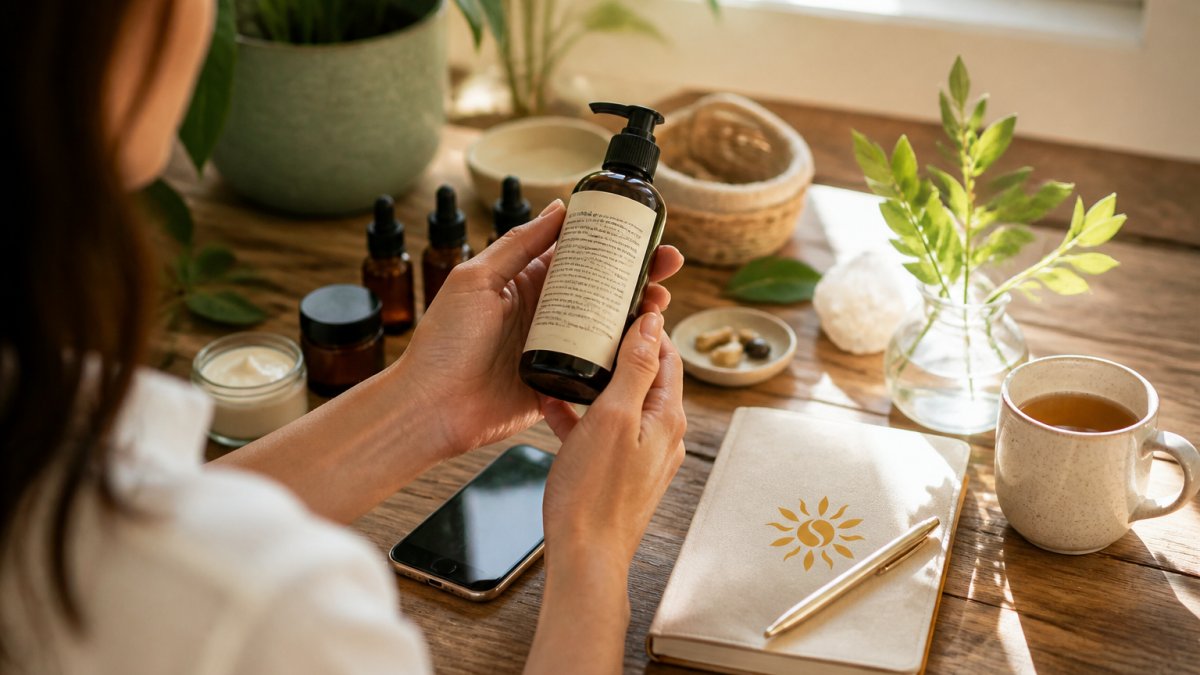
Ingredient lists follow a specific order by law. The first ingredient makes up the largest percentage of the product. Each ingredient after that appears in descending order by concentration.
Here's what most guides miss: the order tells you whether a product is actually what it claims to be.
Understanding INCI Names and Labeling Standards
INCI names are the standardized chemical names cosmetics companies must use on labels. INCI stands for International Nomenclature of Cosmetic Ingredients. Every product sold in the US and most other markets uses INCI names by law.
This creates a language barrier. Common ingredients have INCI names that look nothing like their everyday names:
- Vitamin C is "L-Ascorbic Acid"
- Rosehip is "Rosa Canina Fruit Oil"
- Niacinamide is "Niacinamide" (that one's straightforward)
- Squalane is "Squalane"
Learning to recognize INCI names is your first defense against greenwashing. A brand might say "packed with botanical extracts" but list only one plant oil in the entire formula. Or it might use the botanical's INCI name in tiny print while marketing the common name prominently.
Ingredient Concentration and Exposure: What Order Tells You
The order of ingredients reveals concentration in a way marketing never will. Ingredients listed first are present in the highest amounts. Ingredients listed last might be present in trace amounts, sometimes less than 1%.
This matters because ingredient concentration determines whether something is actually effective or just window dressing. A moisturizer with hyaluronic acid as the fourth ingredient is different from one where it appears as the fifteenth.
Pay attention to where beneficial ingredients appear:
- Top 5 ingredients: These drive the product's primary function
- Middle 5-10: Supporting ingredients that enhance texture or stability
- Last 5+: Preservatives, fragrance, and trace actives for marketing appeal
A product claiming "peptide-rich formula" with peptides listed in the final three ingredients is relying on marketing more than formulation.
Decoding Full INCI Ingredient Lists for Complete Transparency
A full INCI ingredient list shows you everything. No exceptions, no hidden percentages, no proprietary blends. This is what complete transparency looks like.
What Full Disclosure Means and Why Hidden Formulas Matter
Full disclosure means publishing every single ingredient with its INCI name, nothing grouped under vague terms like "proprietary blend" or "fragrance complex." When a brand won't share its full formula, it's usually hiding something, either low-quality ingredients, high percentages of cheap fillers, or formulation choices that don't match the marketing.
Hidden formulas create real problems:
- You can't identify ingredients you're allergic to
- You can't verify safety claims
- You can't compare products objectively
- You have no way to know if the price reflects the ingredients or just the packaging
A brand that publishes full INCI lists is confident in its formulation. It invites scrutiny because the ingredients speak for themselves.
Using Cosmetics Databases to Verify Ingredient Claims
Once you have the full INCI list, use independent cosmetics databases to verify what you're looking at. These databases aggregate ingredient information, safety data, and research.
Common databases include:
- INCIDecoder: Breaks down ingredients by function and provides research summaries
- EWG Skin Deep: Rates ingredients on hazard levels (though ratings vary by methodology)
- CosIng: The official EU cosmetics ingredients database
- Cosmetic Ingredient Review (CIR): Independent safety assessments of cosmetic ingredients
These tools let you:
- Verify ingredient functions (is this really a preservative, or is it marketing?)
- Cross-reference safety information
- Find research on specific ingredients
- Compare formulations across brands
Enter the full ingredient list into a database. Look for patterns. If a brand claims "clean" but uses ingredients flagged for concerns in multiple databases, that's a red flag worth investigating further.
Using a Clean Beauty Ingredient Checker to Evaluate Safety
Ingredient checkers are tools that scan product barcodes or ingredient lists and provide hazard ratings. They're convenient but have important limitations you need to understand.
How Hazard Ratings Work and What They Actually Mean
Hazard ratings attempt to score ingredients on a scale (usually 1-10, with higher numbers indicating more concern). These ratings come from different methodologies, different data sources, and different definitions of "hazard."
Here's what most people get wrong: a high hazard rating doesn't mean an ingredient is unsafe in the amount used in a product.
For example, water has a hazard rating of 1 (very safe). But you could drown in water.
Understanding hazard ratings requires context:
- Hazard = the ingredient's potential to cause harm
- Risk = hazard combined with exposure (amount and frequency)
- A high-hazard ingredient in trace amounts might pose lower risk than a low-hazard ingredient you use daily in large quantities
Resolving Conflicting Safety Ratings Across Different Tools
Different tools rate the same ingredient differently. You might see an ingredient rated as "safe" in one database and "concerning" in another. This creates confusion.
The conflicts exist because rating systems use different criteria:
- Some focus on regulatory approval (is it banned anywhere?)
- Some emphasize research gaps (do we have enough safety data?)
- Some weight animal testing results differently
- Some prioritize environmental impact over skin safety
When you see conflicting ratings, dig deeper:
- Check the rating system's methodology (how did they score this?)
- Look for the original research the rating cites
- Consider the source's bias (is this a commercial tool or independent research?)
- Ask: Is the conflict about the ingredient itself, or about how different organizations weigh risk?
A practical approach: if an ingredient appears in multiple databases with mostly consistent ratings, and it's used by major brands, it's likely safe in formulation context. If ratings are wildly different, the ingredient might have legitimate controversy, and that's worth understanding before deciding.
Spotting Greenwashing in Beauty Products and Claims
Greenwashing is marketing language designed to make products sound cleaner or more natural than they actually are. The beauty industry is full of it.
Red Flags: Clean Claims Without Evidence or Testing
Clean beauty claims often sound specific but mean nothing. Watch for these red flags:
- "Natural" with no definition: Everything comes from nature, including petroleum and arsenic. The term "natural" has no legal definition in cosmetics.
- "Chemical-free" formulations: All products are made of chemicals. Water is a chemical. This claim is impossible and signals marketing over substance.
- "Clinically proven" without citing the study: Proven to do what, exactly? In whose study? For how long?
- "Dermatologist approved" without specifics: Approved by which dermatologists? For what use? This is often just a paid endorsement.
- "Toxin-free" without naming the toxins: Every substance is toxic at some dose. This claim is meaningless without context.
The strongest claims come with evidence. A brand should be able to show you:
- The actual research study (not just a summary)
- The study's methodology and sample size
- Independent verification of results
- Specific, measurable claims (not vague promises)
Verifying Third-Party Testing, Certifications, and Lab Reports
Third-party testing means an independent laboratory tested the product, not the brand itself. This carries weight because there's no financial incentive to fake results.
Real third-party testing includes:
- A certificate of analysis from the lab
- Specific test parameters (what was tested?)
- Test dates and batch numbers
- The lab's credentials and accreditations
Many brands claim certifications they don't have. A product might say "clean beauty certified" but the "certification" is just the brand's own standard, not a third-party verification.
Legitimate certifications come from organizations like:
- NSF International: Tests for specific contaminants
- Leaping Bunny: Verifies cruelty-free status
- USDA Organic: Confirms organic ingredient sourcing
- EcoCert: Evaluates environmental and sustainability claims
Ask brands directly: Can you provide the actual lab report? Which independent lab performed testing? What specific contaminants were screened? A brand confident in its testing will share documentation. One that deflects or says "we test internally" is hiding something.
A Practical Verification Workflow: Questions to Ask Brands
Use this workflow to verify any brand's transparency claims before buying.
Step 1: Request the full INCI list. If a brand won't provide it, move on.
Step 2: Check ingredient order. Enter the list into INCIDecoder or CosIng.
Step 3: Cross-reference safety data. Look up key ingredients in multiple databases. Are ratings consistent?
Step 4: Verify testing claims. Ask the brand: Do you have third-party lab reports?
Step 6: Assess claim substantiation. If the brand claims "clinically proven" benefits, ask for the study.
This workflow takes 15-20 minutes per brand.
Conclusion: Building Your Transparency Checklist
Verifying clean beauty ingredient transparency is a skill, not a one-time check. The more you practice, the faster you spot greenwashing and identify truly transparent brands.
Start with this checklist:
- Brand publishes full INCI ingredient lists (no hidden formulas)
- Ingredient order matches marketing claims
- Key ingredients appear in meaningful concentrations
- Brand provides third-party lab reports or certificates of analysis
- Certifications are verifiable on the certifying body's website
- Claims are specific and backed by actual research
- Brand responds transparently to ingredient questions
At Soulari Naturals, we've built our entire approach around this principle. Our botanical clean standard means full INCI lists with no hidden formulas.
The brands that hide their formulas aren't protecting trade secrets, they're protecting margins. The ones that publish complete ingredient lists are inviting you to verify their claims.
Start asking these questions. Check the databases. Request the lab reports.
Frequently Asked Questions
What does full INCI disclosure mean on a beauty product label?
Full INCI disclosure lists every ingredient in the product using International Nomenclature of Cosmetic Ingredients (INCI) names, in descending order by concentration. This transparency prevents brands from hiding formulas under vague terms like 'proprietary blend' or 'fragrance,' which can mask undisclosed ingredients or contaminants. Brands committed to ingredient transparency provide complete INCI lists so consumers can verify exactly what they're applying to their skin and cross-reference safety data.
How can you tell whether a clean beauty brand is transparent?
Transparent clean beauty brands publish full INCI ingredient lists on their website or product packaging, not just marketing names. They provide third-party testing documentation, certifications, or lab reports verifying their claims. They answer specific questions about ingredient sourcing, manufacturing practices, and contaminant screening. They also disclose any limitations or who their products may not suit, rather than making universal claims. Brands that hide formulas, refuse to share testing data, or use vague language like 'natural' without evidence are likely greenwashing.
How can I spot greenwashing in clean beauty claims?
Greenwashing appears when brands claim 'clean,' 'natural,' or 'toxin-free' without evidence, third-party verification, or specific ingredient data. Watch for vague terms like 'proprietary blend' that hide the actual formulation. Claims about sustainability or ethical sourcing without certifications or supply-chain transparency are also red flags. Compare the brand's marketing language to their actual INCI lists and testing documentation. If the claims sound impressive but the ingredient list or lab reports don't support them, the brand is likely greenwashing rather than delivering real transparency.
Are ingredient-checking apps accurate for beauty products?
Ingredient-checking apps provide a helpful starting point for understanding ingredient safety, but they are not definitive. Apps assign hazard ratings based on available toxicology data, but ratings can vary between apps because they use different methodologies, data sources, and risk thresholds. Concentration matters too: an ingredient rated as hazardous at high exposure may be safe in a 0.1% formulation. Apps also cannot account for finished-product testing, manufacturing contaminants, or individual sensitivities. Use apps as a research tool, but verify critical claims with brand documentation, third-party lab reports, and dermatologist input if you have sensitive skin.
Building a transparent skincare routine starts with brands that show you everything. Soulari Naturals provides full INCI lists, plant-based actives supported by science, and no hidden formulas. Shop Skincare and start verifying exactly what goes on your skin.