 how-to
How to Read Skincare Ingredient Labels: 2026 Guide
Table of Contents
- Why Reading Skincare Ingredient Labels Matters
- How to Read an INCI List: The Format Decoded
- Skincare Label Examples: What the First Five Ingredients Reveal
- How to Use a Skincare Ingredient Checker
- Clean Beauty Label Claims: What to Verify
- Label Differences by Market and Product Category
- Conclusion: Your Accessible Label-Reading Workflow
- Frequently Asked Questions
Last Updated: October 12, 2026
Why Reading Skincare Ingredient Labels Matters
Learning how to read skincare ingredient labels is the fastest way to know what you're actually putting on your skin. The label lists every ingredient in a fixed, regulated order, so once you understand the format, you can judge a product in under a minute.
At Soulari Naturals, we publish full INCI lists on every product for exactly this reason. We believe you should be able to check our formulas the same way you check anyone else's.
Here's the problem. Most shoppers scan the front of the bottle, see words like "botanical" or "clean," and trust it. The back label tells the real story.
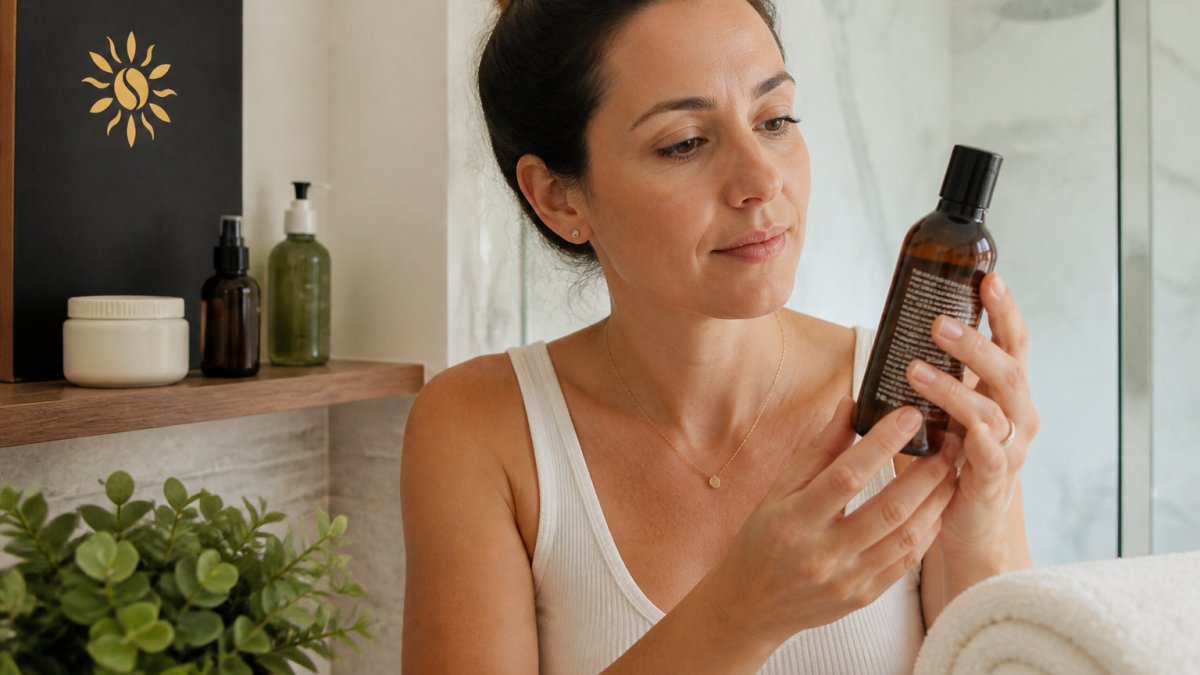
The FDA guidance on cosmetic labeling requires companies to list ingredients in a set order. That rule is your biggest advantage as a shopper. It turns a confusing wall of text into a readable map of the formula.
So let's decode it.
How to Read an INCI List: The Format Decoded
INCI stands for International Nomenclature of Cosmetic Ingredients. It is a standardized naming system used worldwide so the same ingredient appears with the same name on every label, in every country. That standardization is what makes cross-brand comparison possible at all.
Here's how the format works:
- Ingredients appear in descending order by concentration
- The first ingredient is almost always water (listed as "Aqua" or "Water")
- Names use scientific and Latin terms for botanicals
- Color additives appear at the end by Color Index number
- Anything under 1% can be listed in any order
That last point changes everything. More on it next.
The 1% Threshold and Ingredient Order Exceptions
Ingredients at or below 1% concentration can be listed in any order the maker chooses. This is the single most misunderstood rule in cosmetic labeling, and it is the reason two products with identical formulas can print their ingredient lists in different sequences.
Why does the rule exist? Above 1%, the order is a genuine concentration ranking. Below 1%, the amounts are small enough that the ranking carries little practical meaning, so regulators allow flexibility. The threshold is not a quality signal, it is a labeling convenience.
Why does it matter to you? Because active ingredients like retinol, niacinamide, or vitamin C often sit below 1%. Their position near the end of a list tells you nothing about whether they work. A retinol at 0.3% and a retinol at 0.9% can both appear after the preservatives, in either order.
So when you compare two products, don't judge by position alone. Look for the ingredient, not where it sits.
What the label can and cannot tell you about concentration
This is the part most guides skip. An ingredient list is a ranked list, not a recipe. It can tell you:
- Which ingredients are present
- That the first several are the bulk of the formula
- That anything below 1% is in flexible order
It cannot tell you:
- The exact percentage of any ingredient
- Whether an active is at a clinically studied level
- Whether two products with the same active are equivalent
A label rarely reveals exact concentrations because formulators treat them as proprietary, and because most markets do not require percentage disclosure for ordinary cosmetics. Sunscreen and acne drugs are the main exceptions in the US, where active percentages are regulated and printed.
A worked example
Imagine two serums. Both list: Aqua, Glycerin, Niacinamide, Panthenol, Phenoxyethanol, Retinol.
- Serum A may be 5% niacinamide and 0.1% retinol.
- Serum B may be 2% niacinamide and 0.5% retinol.
The lists look identical. The formulas are not. The only way to know is to check whether the brand publishes percentages, or to look for a concentration claim in the product's own marketing, and then treat that claim as a claim, not a verified fact.
How to read around the 1% rule
A practical habit: scan the list for the ingredient you care about, then check the brand's own materials for a stated percentage. If no percentage is published, treat the product as "contains the ingredient" rather than "contains an effective dose." That single shift in reading prevents most label-based mistakes.
Skincare Label Examples: What the First Five Ingredients Reveal
The first five ingredients tell you what the product mostly is. Read them like a recipe's main components.
Take a simple moisturizer:
- Aqua (water) - the base
- Glycerin - a humectant that pulls water into skin
- Caprylic/Capric Triglyceride - an emollient that softens
- Niacinamide - an active that supports the skin barrier
- Sodium Hyaluronate - a form of hyaluronic acid that holds moisture
That's a hydrating formula. The first five confirm it before you read another word.
Now compare that to a product where water, alcohol, and fragrance lead the list. That formula is built differently, and your skin will feel it.
Identifying Active vs. Inactive Ingredients
Active ingredients are the ones doing the work: retinol, vitamin C, niacinamide, salicylic acid, and similar. Inactive ingredients support the formula: water, emulsifiers, preservatives, and texture agents.
Here's what most guides miss. In skincare, "active" isn't always a legal category the way it is in sunscreen or acne drugs. Many brands use the word loosely. So check the actual ingredient name, not the marketing label.
How to Use a Skincare Ingredient Checker
A skincare ingredient checker is a tool or database that lets you paste an ingredient list and see what each item does. These tools help you spot potential irritants, allergens, and comedogenic ingredients fast.
A good workflow looks like this:
- Copy the full INCI list from the product page
- Paste it into a checker or search each name
- Flag anything linked to your skin concerns
- Note the ingredient function for the top five
- Save the list if the product works for you
Don't rely on a checker alone. It gives you data, not a verdict. Your skin type decides what works.
Ingredient Interactions and Formulation Context
This is the part a checker cannot do for you. Ingredients don't work alone. They interact, and the formula around them matters as much as the ingredient itself.
Consider four factors a single ingredient name hides:
- Concentration, the same active at 0.1% and 1% behaves differently
- pH, acids like glycolic and salicylic need a low pH to exfoliate; in a neutral formula they mostly just hydrate
- Delivery system, encapsulated retinol releases more slowly and irritates less than free retinol at the same percentage
- Combination, retinol and strong acids used together can overwhelm skin; vitamin C and niacinamide work fine together in most modern formulas, despite older advice to avoid the combo
Preservatives keep water-based products safe, and skipping them isn't cleaner, it's riskier. A formula with no preservative system is a formula with a microbial growth problem waiting to happen.
This is the context a single ingredient name can't give you. Read the whole list, not one line.
A practical way to use a checker without over-trusting it
Treat the checker as a translation layer, not a judge. Use it to learn what unfamiliar names mean, then apply your own context:
- Identify the actives and their stated or implied concentrations
- Note the base (water, oil, alcohol) and the preservative system
- Check whether the brand discloses pH or delivery technology
- Cross-reference against your own known triggers
- Patch test before committing to full-face use
The checker tells you what is in the bottle. It cannot tell you how the formula behaves on your skin. That judgment stays with you.
Clean Beauty Label Claims: What to Verify
"Clean," "natural," and "organic" are marketing claims, not regulated terms in most markets. That means any brand can print them.
Here's what to verify instead:
- Certifications with a named body you can look up
- Full INCI lists, not partial ones
- "Fragrance" vs. "Parfum" disclosures
- Color additives listed by Color Index number
- Organic claims backed by a certifier
Our botanical clean standard means every Soulari Naturals product features a complete INCI list and no hidden formulas. That's a claim you can check, not just read.
Label Differences by Market and Product Category
Labeling rules vary by country and by product type. The EU cosmetics regulation overview and the FDA's cosmetic versus drug rules set different requirements, which is why the same product can carry two different labels.
Category matters too:
| Category | Key Label Difference | What to Check |
|---|---|---|
| Moisturizers | Actives often under 1% | Ingredient name, not position |
| Sunscreen | Actives regulated as drugs (US) | SPF and active % |
| Serums | Concentrated, short lists | First five ingredients |
| Cleansers | Surfactants lead the list | Harsh vs. mild surfactants |
| Supplements | Not cosmetics at all | Third-party testing |
If you buy across borders, expect the order and names to shift. The INCI system keeps names consistent, but local rules still apply.
Conclusion: Your Accessible Label-Reading Workflow
Reading skincare ingredient labels comes down to a repeatable habit, not a chemistry degree. Check the first five ingredients, scan for your known irritants, and ignore the front-of-bottle claims.
That's where Soulari Naturals fits. Every formula ships with a full INCI list, plant-based actives, and no hidden formulas, so you can verify what you're buying. Our products support radiant skin and whole-body vitality through a holistic approach.
Ready to read a label you can actually trust? Shop Skincare with Soulari Naturals and see the full ingredient list on every product.
Frequently Asked Questions
How do you read an INCI ingredient list?
INCI lists use standardized Latin or English names for ingredients, always listed in descending order of concentration. Start by scanning the first five ingredients to understand the base formula, then look for active ingredients like niacinamide or retinol. Ingredients below the 1% threshold can be listed in any order, so check for preservatives like phenoxyethanol to estimate where that line falls. This method helps you compare products accurately.
Are skincare ingredients listed in order of concentration?
Yes, ingredients are listed in descending order of concentration until the 1% threshold. After that point, ingredients at 1% or less can appear in any order. This means the first five ingredients tell you most about the formula's base. If water or glycerin appears first, the product is water-based. If you see retinol or vitamin C listed after preservatives, it is likely present at a low concentration.
How can you tell if a skincare ingredient may irritate your skin?
Look for common potential irritants like fragrance, parfum, essential oils, and certain preservatives. If you have sensitive skin, patch test new products on your inner forearm for 24 hours before applying to your face. A skincare ingredient checker can flag known allergens. Also note that botanical extracts, while natural, can still trigger reactions. Always introduce one new product at a time to isolate any issues.
How can you spot greenwashing in clean beauty claims?
Greenwashing uses vague terms like natural or botanical without proof. Check for full INCI lists. If a brand claims clean but hides ingredients behind proprietary blends, be skeptical. Also verify if the brand provides sourcing details. A clean beauty label claim is only meaningful if you can trace it to a standard or audit.