 blog
blog
Natural Skincare Products: 2026 Guide to Clean Beauty
Table of Contents
- Why Natural Skincare Products Are More Than a Trend
- Toxic Ingredients to Avoid in Skincare: What Your Label Isn't Telling You
- How to Read Skincare Labels: A No-Nonsense Guide to INCI Lists
- Natural vs. Synthetic Ingredients: What the Science Actually Says
- Natural Skincare Routine for Beginners: A Simple 4-Step Framework
- Allergy and Patch Testing: The Step Most People Skip
- Shelf Life, Preservation, and Why Natural Formulas Need Extra Care
- Conclusion: Building a Routine You Can Trust
- Frequently Asked Questions
Last Updated: September 28, 2026
Why Natural Skincare Products Are More Than a Trend
Natural skincare products have moved from niche to mainstream, and the numbers back it up. According to Statista's global beauty market data, demand for clean, plant-based formulations continues to climb year over year. This guide from Soulari Naturals cuts through the marketing noise to help you understand how to choose products.
Toxic Ingredients to Avoid in Skincare: What Your Label Isn't Telling You
The most common toxic ingredients to avoid in skincare include synthetic fragrances, parabens, sulfates, and phthalates. These appear on labels under dozens of different names, which is why so many shoppers miss them.
Here is what to watch for:
- Parabens (methylparaben, propylparaben): preservatives linked to hormone disruption concerns
- Sulfates (SLS, SLES): harsh surfactants that strip the skin barrier
- Phthalates: often hidden inside "fragrance" on ingredient lists
- Synthetic fragrances: a catch-all term that can mask hundreds of compounds
How to Read Skincare Labels: A No-Nonsense Guide to INCI Lists
Reading skincare labels starts with the INCI list, the International Nomenclature of Cosmetic Ingredients, the standardized system used worldwide to name every ingredient in a formula.
Red Flags and Green Flags on Ingredient Lists
Red flags include vague terms like "fragrance," "parfum," and "proprietary blend" with no breakdown. Green flags include full INCI disclosure, named botanical extracts, and clear sourcing notes.
Natural vs. Synthetic Ingredients: What the Science Actually Says
The honest answer is that neither category wins outright. The better question is not "natural or synthetic?" but "what does this specific molecule do, at what concentration, in what formula?"
The Same Molecule, Two Origins
Many actives exist in both worlds. L-ascorbic acid can be isolated from citrus or synthesized in a lab, and the molecule is chemically identical either way. What differs is purity, stability, and delivery.
- Natural-source vitamin C often arrives inside a botanical extract alongside flavonoids and other co-factors that can support antioxidant activity, but the concentration of the active itself is harder to standardize.
- Synthesized vitamin C can be produced at a known purity and paired with stabilizing partners (like ferulic acid or vitamin E) at precise ratios, which is why many dermatology-formulated serums use it.
Where Natural Ingredients Genuinely Excel
Plant oils and butters are not marketing filler, many are rich in fatty acids that mirror the skin's own lipid barrier.
- Jojoba oil is structurally close to human sebum, which is why it is often well tolerated by both dry and acne-prone skin.
- Squalane (whether olive-derived or sugarcane-derived) is a lightweight emollient that helps reduce transepidermal water loss without a heavy feel.
- Shea butter and cocoa butter deliver occlusive protection and are common in barrier-repair formulas.
- Green tea, chamomile, and oat extracts contain polyphenols and avenanthramides that are widely used in formulas for reactive or sensitized skin.
Where Synthetics Genuinely Excel
Synthetics win on three fronts: stability, precision, and reproducibility.
- Retinoids such as tretinoin and adapalene are lab-made and dose-controlled, which is why they are the reference points in dermatology for photoaging and acne.
- Niacinamide and hyaluronic acid are typically produced at high purity, so a 5% or 10% claim on a label is meaningful.
- Preservation systems built on synthetic or nature-identical preservatives keep water-based formulas safe for months. This is the unglamorous reason many "preservative-free" natural products either contain no water or rely on packaging that limits microbial exposure.
Synthetics are chosen when consistency matters more than story; botanicals when the formula benefits from a complex mixture of co-factors.
The Trade-Off Table, With the Missing Column
| Factor | Natural Ingredients | Synthetic Ingredients |
|---|---|---|
| Stability | Shorter shelf life; sensitive to light, heat, and oxygen | Longer shelf life; easier to stabilize |
| Purity | Varies by batch, harvest, and extraction method | Highly consistent and standardized |
| Allergy risk | Possible with botanicals (essential oils, fragrances, some plant proteins) | Possible with additives, preservatives, and fragrance compounds |
| Skin barrier support | Strong with plant oils, butters, and ceramide-like lipids | Depends on formulation; can be excellent with ceramides and fatty alcohols |
| Environmental impact | Depends on sourcing, farming, and extraction | Depends on production energy and waste streams |
| Dose accuracy | Harder to standardize active concentration | Easy to standardize and verify |
The Point Most Guides Miss
"Natural" and "safe" are not synonyms. Poison ivy is natural; many lab-made ingredients have decades of safety data behind them.
- The specific ingredient, not its origin story
- The concentration, a 0.1% botanical extract and a 10% one behave very differently
- The delivery system, encapsulation, pH, and packaging decide how much active reaches skin
- Your individual skin, barrier status, allergies, and current actives all change the equation
A Practical Way to Compare Any Two Products
When one bottle says "botanical" and the other says "clinical," run this quick check:
- Find the active on the INCI list and note its position (earlier = higher concentration)
- Check whether the formula includes stabilizers, chelators, or antioxidants that protect the active
- Look at the packaging: opaque, airless, or pump formats protect sensitive actives better than jars
- Check the period-after-opening symbol for a realistic shelf life
- Patch test before committing, regardless of origin
Natural Skincare Routine for Beginners: A Simple 4-Step Framework
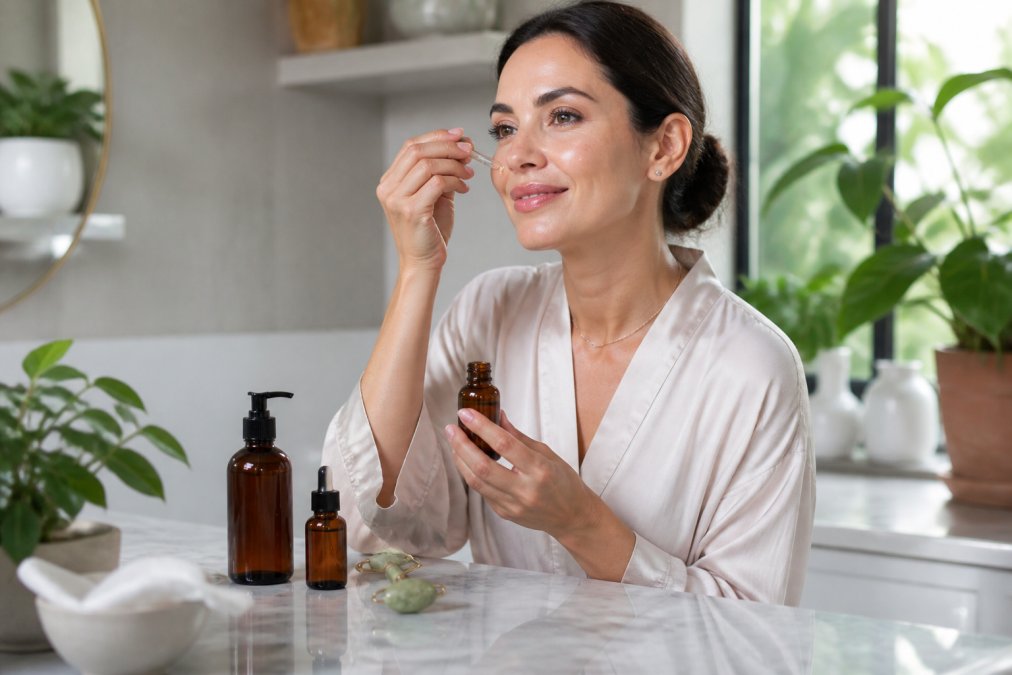
A natural skincare routine for beginners needs only four steps: cleanse, treat, moisturize, and protect. Skip the ten-step rituals. They overwhelm the skin barrier and your budget.
- Cleanse with a gentle, sulfate-free cleanser morning and night
- Treat with an antioxidant serum or botanical active
- Moisturize with a plant-based moisturizer to seal in hydration
- Protect with SPF every morning, rain or shine
Morning vs. Evening: What Changes and What Stays
Mornings prioritize protection: cleanse lightly, apply antioxidants, moisturize, then SPF. Evenings prioritize repair: cleanse thoroughly to remove buildup, apply treatment serums, and moisturize more heavily.
The Transition Plan Most Beginners Get Wrong
The biggest mistake new natural-skincare users make is swapping every product on the same day, which makes it impossible to tell which product helps and which causes a reaction. Natural formulas, with their botanicals and essential oils, are also more likely than synthetic ones to trigger contact dermatitis in sensitive skin.
A safer transition looks like this:
- Week 1-2: Replace only your cleanser. Keep everything else the same.
- Week 3-4: Swap in one treatment product (serum or active). Introduce it every other night before going nightly.
- Week 5-6: Replace your moisturizer.
- Week 7+: Add SPF and any optional extras (masks, oils, exfoliants) one at a time.
A Safety-First Checklist Before You Start
Natural ingredients are common allergens. Essential oils (lavender, citrus, tea tree, eucalyptus), botanical extracts, and some plant proteins frequently trigger contact dermatitis. Before committing to a full routine:
- Patch test every new product behind your ear or on your inner forearm for 24 hours
- Repeat the patch test on a small area of your face for another 24 hours
- Introduce only one new product at a time
- Keep a simple log of what you used and when, so you can trace reactions
- Stop immediately if you see spreading redness, swelling, or itching, and see a dermatologist if it does not settle
Budget-Friendly Ways to Build the Routine
You do not need ten products. A cleanser, one antioxidant serum, a moisturizer, and a sunscreen cover the essentials; masks, facial oils, and exfoliants are optional once your baseline routine is stable.
What to Expect in the First 8 Weeks
Skin turnover takes roughly four to six weeks, so give any new routine at least that long before judging results. Early weeks may bring minor purging or dryness as your barrier adjusts. If irritation persists past two weeks, simplify back to cleanser, moisturizer, and SPF, then rebuild one step at a time.
Allergy and Patch Testing: The Step Most People Skip
Patch testing is the most skipped step in skincare, and the one that prevents the worst reactions. Even plant-based formulas can trigger contact dermatitis in sensitive skin.
Here is a reliable patch test method:
- Apply a small amount behind your ear or on your inner forearm
- Leave it untouched for 24 hours
- Check for redness, itching, or swelling
- If clear, repeat on your face with a small area
- Wait another 24 hours before full application
Shelf Life, Preservation, and Why Natural Formulas Need Extra Care
Natural formulas generally have shorter shelf lives than synthetic ones because they rely on gentler preservation systems, a trade-off, not a flaw.
Conclusion: Building a Routine You Can Trust
The hardest part of clean beauty is not finding products. It is finding ones you can actually verify. That is the challenge Soulari Naturals addresses.
Frequently Asked Questions
How can I tell if a skincare product is truly natural?
Check the INCI list for recognizable botanical extracts, cold-pressed oils, and plant-based actives. Look for third-party certifications and full disclosure of every ingredient. Be wary of vague terms like 'botanical blend' or 'natural fragrance' that hide synthetic components. A brand committed to transparency will list everything, including preservatives, so you can verify what you're putting on your skin.
What toxic ingredients should I avoid in skincare?
Common ones to watch for include synthetic fragrances (which can contain phthalates), parabens, sulfates like SLS, and formaldehyde-releasing preservatives. Also check for PEG compounds and silicones that can clog pores. If you have sensitive or acne-prone skin, these are especially worth avoiding. Always read the full INCI list rather than relying on front-of-pack claims like 'clean' or 'non-toxic.'
Is natural skincare better for sensitive skin?
Not automatically. Some botanical extracts and essential oils can trigger reactions in sensitive skin. What matters is formulation quality, concentration, and whether the product is dermatologist-tested and hypoallergenic. Patch testing is essential before committing to a full routine. Natural products with fewer synthetic additives can be gentler, but only if the botanical actives are well-tolerated by your skin.
What is the difference between organic and natural skincare?
Natural means ingredients come from natural sources, but they may still be processed or grown with pesticides. Organic means the ingredients meet specific agricultural standards, like no synthetic fertilizers or pesticides. A product can be natural without being organic. For the cleanest option, look for both labels plus full INCI transparency and ethical sourcing information.