 blog
blog
Natural Alternatives to Synthetic Skin Brighteners
Table of Contents
- Why Natural Skin Brighteners Matter
- Natural Skin Brightening Ingredients That Work
- Natural Alternatives to Hydroquinone
- How to Brighten Skin Naturally
- Skin Brightening Routine for Dark Spots
- Safety and Realistic Expectations
- Conclusion
- Frequently Asked Questions
Last Updated: October 5, 2026
Why Natural Skin Brighteners Matter
Dark spots and uneven skin tone affect millions and feel permanent. Many reach for synthetic brightening agents like hydroquinone, which work fast but raise concerns about long-term safety and irritation.
Natural alternatives to synthetic skin brighteners have emerged as a real option because they work: some plant compounds inhibit melanin production, others reduce the inflammation behind post-inflammatory hyperpigmentation.
This guide covers what natural ingredients do, how they compare to synthetics, and whether they suit your skin.
Natural Skin Brightening Ingredients That Work
The most effective natural alternatives to synthetic skin brighteners share one thing: they've been studied. Here are the botanical actives that show real promise:
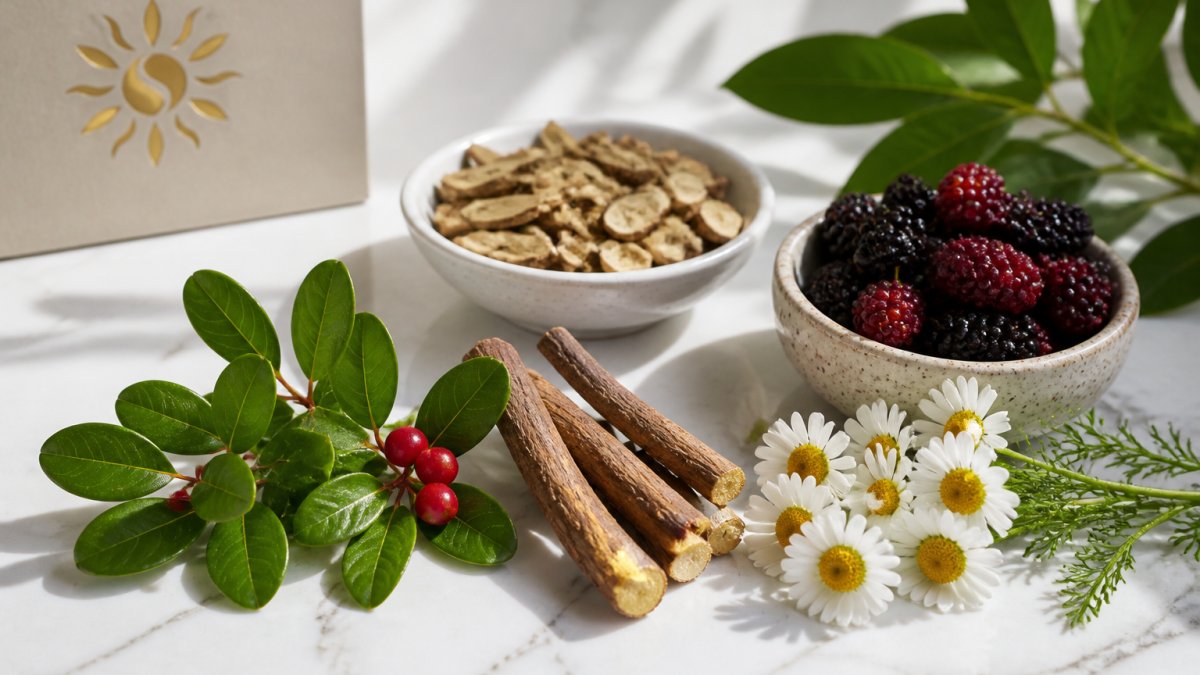
Vitamin C and Antioxidant Power
Vitamin C is one of the most researched brightening ingredients.
Kakadu plum is nature's richest vitamin C source, with up to 55 times more than an orange.
Arbutin and Bearberry Extract
Arbutin, found in bearberry leaves, inhibits tyrosinase, the enzyme that produces melanin, so production slows and dark spots fade.
Arbutin doesn't work overnight: most people see fading in 4-8 weeks of consistent use.
Licorice Root Extract and Botanical Actives
Licorice root inhibits tyrosinase and reduces inflammation simultaneously, valuable for sensitive or redness-prone skin. Mulberry extract does the same and amplifies other botanical brighteners.
These ingredients work best in combination: a formula with vitamin C, arbutin, and licorice root addresses hyperpigmentation through multiple mechanisms, beating any single ingredient.
Natural Alternatives to Hydroquinone
Hydroquinone is often called the gold standard for fading hyperpigmentation: a direct tyrosinase inhibitor many dermatologists consider the most reliably effective single topical agent for moderate to severe pigment. But it carries real trade-offs, irritation, paradoxical darkening (ochronosis) with prolonged unmonitored use, and prescription-only status in many countries, which is why so many people search for natural alternatives to synthetic skin brighteners.
Mechanism: direct suppression vs. multi-pathway modulation
Hydroquinone inhibits tyrosinase and is cytotoxic to melanocytes, it reduces pigment-producing cells, not just their output. That power is why it demands supervision. Most natural brighteners take a softer route:
- Arbutin is essentially a slow-release, glycosylated form of hydroquinone. It still inhibits tyrosinase, but the body converts it gradually, so the skin is exposed to lower, more even levels, a gentler cousin of hydroquinone rather than a replacement.
- Licorice root (glabridin) inhibits tyrosinase and also has anti-inflammatory activity, so it addresses both the pigment and the irritation driving post-inflammatory hyperpigmentation.
- Vitamin C does not primarily block tyrosinase; it interrupts the oxidation steps in melanin synthesis and neutralizes the free radicals that trigger pigment production.
- Niacinamide (a vitamin, not a botanical, but a common 'natural-adjacent' option) reduces the transfer of melanin from melanocytes to surrounding skin cells rather than blocking production.
- Daisy flower and mulberry extracts also act on melanin transfer and tyrosinase activity, respectively.
Hydroquinone hits one target hard; natural actives hit several softly. For mild, recent, or surface-level pigment that's often enough; for deep or widespread pigment, frequently not.
Evidence quality: what the research actually supports
Evidence for these ingredients is not equal:
- Strongest human evidence among naturals: topical niacinamide and topical vitamin C (in stabilized, adequately concentrated formulas) have the most consistent clinical backing for improving uneven tone and fading spots.
- Moderate evidence: arbutin and licorice-derived glabridin have supportive but smaller studies; results are real but typically measured over 8-12 weeks.
- Weaker or mostly traditional-use evidence: many botanical extracts (daisy, mulberry, some mushroom extracts) are supported more by in-vitro (lab-dish) studies and long traditional use than by large human trials. That does not make them useless, it means the marketing often outruns the data.
A useful rule: when a brand claims a botanical 'fades dark spots,' ask whether the evidence is human clinical, lab-only, or traditional.
Speed and onset: the timeline trade-off
- Hydroquinone: visible lightening often begins in 4-8 weeks, sometimes sooner, under supervision.
- Stabilized vitamin C: 8-12 weeks for meaningful change.
- Arbutin and licorice: commonly 4-8 weeks for early fading, with fuller results at 8-12 weeks.
- Niacinamide: often 4-8 weeks for tone improvement.
The pattern is consistent: natural actives are slower.
Irritation and risk profile
Hydroquinone's risks, irritation and, with long-term unsupervised use, ochronosis, are well documented.
A practical hybrid approach
Many land on a middle path: natural actives as the everyday routine, and hydroquinone, under dermatologist guidance, for short, targeted courses when a concern needs faster resolution.
overview of hydroquinone safety and regulatory status
How to Brighten Skin Naturally
Daily Brightening Routine Steps
A natural skin brightening routine for dark spots follows a simple structure:
-
Cleanse gently. Harsh cleansing strips skin and triggers irritation. Use lukewarm water and a mild cleanser, then pat dry.
-
Apply a brightening serum. This is where your natural alternatives to synthetic skin brighteners go. Apply about 3-4 drops to clean, damp skin, pressing gently rather than rubbing.
-
Follow with a hydrating moisturizer. Brightening ingredients work best on well-hydrated skin, and a good moisturizer supports the barrier and reduces irritation.
-
Use this routine twice daily. Morning and evening consistency matters; skip it and you reset your progress.
-
Wait 4-8 weeks before assessing results. Some see results in 3 weeks, others need 12. Skin varies.
The order matters: serums go on clean, damp skin, moisturizers seal them in, and sunscreen comes last in the morning.
Sun Protection and Prevention
This is where most people fail. You can brighten existing spots, but without prevention you're fighting a losing battle: UV triggers melanin overproduction, so unprotected sun exposure creates new dark spots, especially for darker skin tones, who are more prone to post-inflammatory hyperpigmentation. Use broad-spectrum SPF 30+ daily, even cloudy days and indoors, since UV penetrates clouds and windows. Reapply every two hours outdoors.
Skin Brightening Routine for Dark Spots
A targeted routine for existing dark spots differs slightly from general brightening. First, identify the cause: post-inflammatory hyperpigmentation from acne fades faster than sun spots, sun spots need consistent long-term treatment, and melasma requires sun protection as much as actives.
For post-inflammatory hyperpigmentation, start a natural alternatives to synthetic skin brighteners routine as soon as inflammation clears, early treatment prevents permanent spots. For sun spots, consistency beats intensity: use your routine daily for at least 8-12 weeks, with fading often starting around week 6.
Layer your routine strategically:
- Morning: Cleanser → Vitamin C serum → Moisturizer → SPF 30+
- Evening: Cleanser → Brightening serum with arbutin or licorice → Richer moisturizer
This approach targets spots with active ingredients while protecting skin from future damage.
Safety and Realistic Expectations
'Natural' is a sourcing claim, not a safety guarantee. Poison ivy is natural. Lemon juice is natural. Neither belongs on your face.
Natural does not mean non-irritating
Botanical actives can absolutely cause redness, stinging, dryness, and contact allergy. A few cautions worth knowing:
- Citrus and other photosensitizing botanicals: lemon juice, lime, and some citrus-derived extracts make skin more sensitive to UV, worsening the pigmentation you are trying to fade, one of the most common DIY mistakes.
- Essential oils: many 'natural' brightening blends rely on essential oils that are frequent contact allergens, so patch-test carefully.
- High-concentration vitamin C: effective, but it can sting irritated or over-exfoliated skin.
- Abrasive scrubs and 'brightening' physical exfoliants: scrubbing does not fade pigment; it inflames skin and can deepen post-inflammatory hyperpigmentation, especially on darker skin tones.
DIY brightening: why it usually backfires
Patch-testing: the two-minute habit that prevents two-week setbacks
Before applying any new brightening product to your face:
- Apply a small amount to the inner forearm or behind the ear.
- Wait 24-48 hours.
- Check for redness, itching, or bumps.
- If clear, introduce it to your face at 2-3 times per week before going daily.
This matters more with botanical actives, because plant extracts vary batch to batch and allergy can develop over repeated exposure.
Match the approach to the cause, not just the ingredient
Not all dark spots are the same, and one routine won't serve all equally:
- Post-inflammatory hyperpigmentation (PIH): marks left after acne, eczema, or injury. These respond well to anti-inflammatory brighteners (licorice, niacinamide) plus daily sun protection, and fade faster than sun-induced pigment, especially if treated early.
- Sun spots (solar lentigines): driven by cumulative UV exposure. These need consistency over months and will keep returning without rigorous sun protection.
- Melasma: hormonally and UV-driven, often symmetrical on the cheeks, forehead, and upper lip. It is the hardest to treat and most likely to rebound; natural actives can support a routine, but melasma frequently needs professional management, and sun protection is non-negotiable.
Skin tone considerations
The goal of brightening is even tone, not lighter skin.
Pregnancy and nursing
Some botanical actives have limited safety data during pregnancy.
What realistic results actually look like
- Earliest visible change: around 3-4 weeks, and only with consistent use.
- Meaningful fading: typically 8-12 weeks.
- Deep or old spots: may improve but not disappear completely.
- Without daily broad-spectrum sunscreen: results stall or reverse, regardless of how good the actives are.
If a product promises overnight or one-week spot removal, that is a marketing claim, not a mechanism.
Conclusion
Dark spots and uneven tone don't require harsh synthetics. Natural alternatives to synthetic skin brighteners work through proven mechanisms: tyrosinase inhibition, antioxidant protection, and inflammation reduction. Vitamin C, arbutin, licorice root, and bearberry extract deliver visible results when formulated correctly and used consistently.
At Soulari Naturals, we've built our brightening formulas on this foundation. Our botanical clean standard ensures every ingredient serves a purpose. Full INCI lists mean no hidden synthetics. Science-backed plant actives mean results you can see. Shop Skincare and discover how natural brightening can transform your routine.
Frequently Asked Questions
What is the best natural skin brightener for dark spots?
Vitamin C, arbutin, and licorice root extract are among the most studied natural skin brighteners. Vitamin C works as an antioxidant that may help fade hyperpigmentation, while arbutin and licorice both address melanin production. The best choice depends on your skin type and sensitivity, sensitive skin often tolerates licorice and niacinamide well, while vitamin C suits most skin types when stabilized properly. Results typically appear after 6-12 weeks of consistent use.
How do natural skin brighteners compare with synthetic ones like hydroquinone?
Hydroquinone is a potent synthetic brightener that directly inhibits tyrosinase, the enzyme controlling melanin production, often showing faster results. Natural alternatives work more gently through antioxidant action and tyrosinase inhibition, making them suitable for long-term use and sensitive skin. Natural ingredients tend to work slower but carry lower irritation risk, while synthetic brighteners may cause irritation or require medical supervision with extended use.
How long does it take to see results from natural skin brightening products?
Most natural skin brighteners require 6-12 weeks of consistent daily use before visible fading of dark spots or evening of skin tone appears. Results depend on the ingredient concentration, formulation stability, your skin type, and the depth of hyperpigmentation. Post-inflammatory hyperpigmentation may fade faster than sun damage or age spots. Patience and sun protection are essential, UV exposure can reverse progress and deepen existing spots.
Can natural skin brighteners irritate sensitive skin?
While generally gentler than synthetics, some natural brighteners can still cause irritation. Vitamin C serums may irritate if unstable or used at high concentrations. Licorice root and niacinamide are typically well-tolerated by sensitive skin. Always patch-test new products and introduce them gradually. If you have a history of reactions to clean skincare, look for formulations with transparent ingredient lists and consider consulting a dermatologist before starting any brightening routine.